ERP as source of truth and the commercial layer as the industrial execution system
This page is part of our content cluster on B2B sales, pricing, ERP-connected workflows, and commercial automation. If you are evaluating software or researching best practices, use the related links at the end to continue deeper.
For years, many industrial companies tried to run their commercial operation directly from the ERP. The logic sounded reasonable: if the ERP has customers, products, stock, invoices, orders, and accounts receivable, then it should also manage sales, quotes, opportunities, approvals, dashboards, digital channels, and the commercial team.
In practice, that expectation becomes insufficient as the commercial operation scales.
The ERP is fundamental. It should be the system of record: the accounting, financial, and operational source of truth. But it should not be the only interface where selling happens.
Industrial sales lives at a different speed. It needs context, mobility, channels, product images, technical sheets, recommendations, exceptions, approvals, flexible pricing, visible credit, WhatsApp, B2B portals, and follow-up. When companies try to force all of that into the ERP, the commercial team starts working around the system.
The result is familiar: the ERP records what already happened, while the real sale happens in Excel, email, WhatsApp, phone calls, and seller memory.
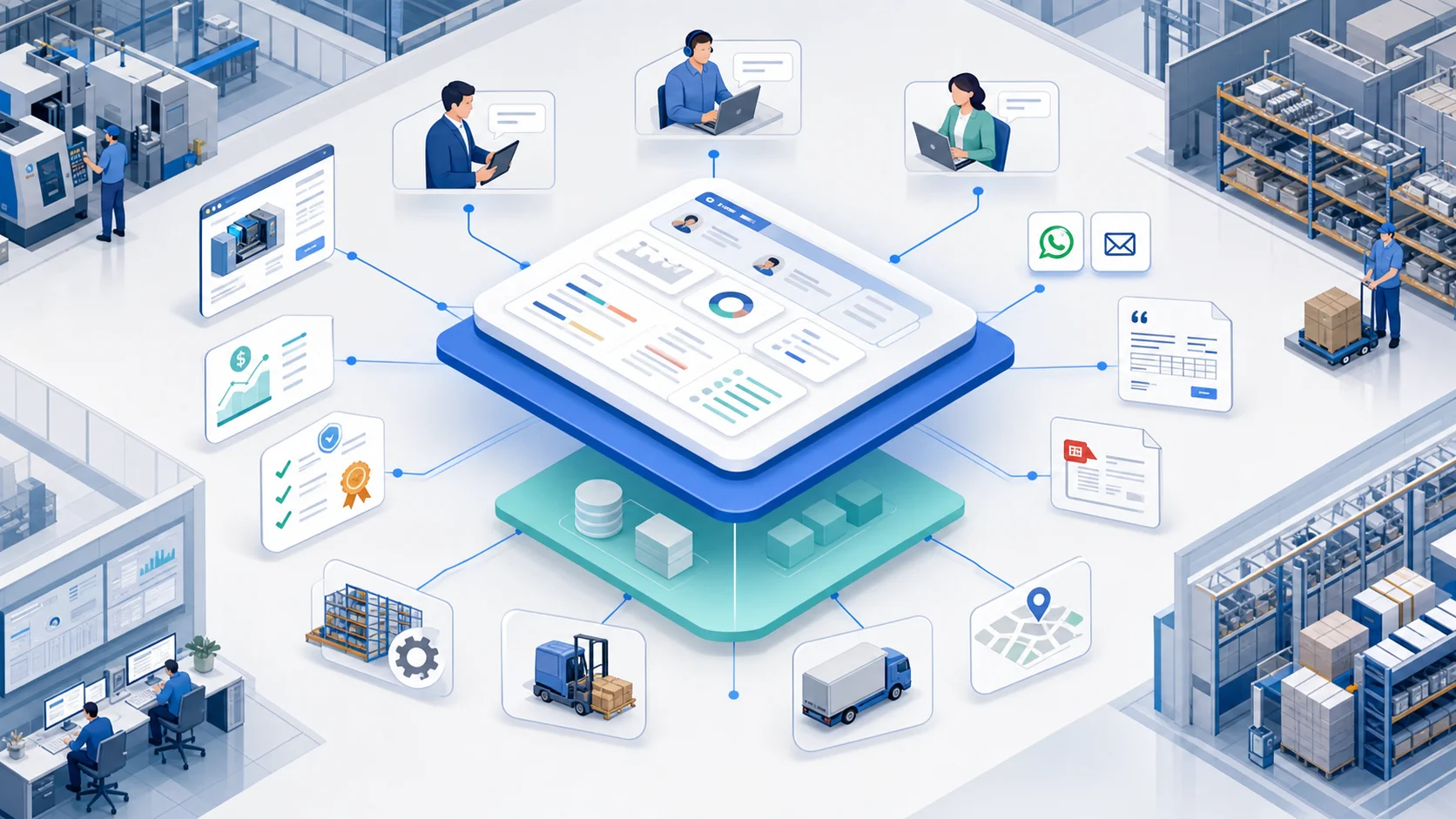
That is why industrial distributors need a new layer: a commercial operating system connected to the ERP, designed to execute sales with speed and control.
Executive diagnosis
The decision is not whether the ERP matters. It matters a lot. The decision is which work should live in the ERP and which work needs a commercial-operational layer designed for customer speed.
| Architecture question | Practical answer | Risk if ignored |
|---|---|---|
| Where should accounting, tax, and operational truth live? | In the ERP, with permissions, auditability, and stable rules. | Duplicate data, difficult closes, and weaker financial control. |
| Where should sales work every day? | In a connected, mobile, contextual layer focused on quoting, selling, and coordination. | The team uses Excel, WhatsApp, and memory as an informal operating system. |
| Where should prices, margin, and exceptions be governed? | In commercial workflows with rules, thresholds, and traceable approvals. | Arbitrary discounts, slow approvals, and margin leakage. |
| Where should digital channels be enabled? | On top of the same commercial layer, not as an isolated portal. | Weak self-service, incorrect prices, and unreliable stock promises. |
| Where can AI operate safely? | In a layer with data, permissions, and controlled actions. | Superficial automation on incomplete information. |
The ERP should remain the system of record
The ERP is not the enemy. It is one of the most important systems in the company.
Accounting accounts, assets, customers, suppliers, purchases, sales, inventory, invoicing, taxes, receivables, and formal operational control should live there. For industrial companies, that is not optional: without a reliable system, operations break.
Finance and accounting need certainty. They need permissions, auditability, consistency, closing processes, traceability, and rules. They cannot operate from informal conversations or personal spreadsheets.
| What the ERP should protect | Why it matters |
|---|---|
| Accounting, taxes, and closing | The basis of financial control and compliance. |
| Invoicing and legal documents | Valid documents, numbering, taxes, and audit trail. |
| Official inventory | Stock, movements, costs, and valuation need one reliable source. |
| Formal orders and purchases | They connect sales, warehouse, procurement, and finance. |
| Customer and supplier master data | Consistent data is needed to sell, collect, buy, and audit. |
| Credit and accounts receivable | They determine risk, cash, and the ability to keep selling. |
The mistake is expecting that same control-oriented logic to be the best experience for selling.
Sales needs a different speed
Sales lives in the opportunity. Finance lives in control. Both are necessary, but they do not behave the same way.
A finance leader wants to avoid errors, duplicates, unauthorized discounts, incorrect documents, and sales to risky customers. A seller needs to answer before competitors, quote from the field, check availability, understand what to offer, negotiate conditions, and keep the relationship alive.
That tension is correct. It should not be eliminated. It should be designed.
| Financial-operational need | Commercial need |
|---|---|
| Control, permissions, and audit. | Speed, context, and autonomy. |
| Consistent master data. | Flexible search and recommendations. |
| Stable processes and accounting close. | Exceptions, negotiation, and fast changes. |
| Formal order and invoice records. | Pre-order management: leads, opportunities, and quotes. |
| Governed risk and credit. | Ability to sell without discovering blockers too late. |
When the company does not separate those needs, one of two things happens: the commercial process becomes slow and bureaucratic, or sales escapes the system to keep operating.
Both are expensive.
The incomplete promise of ERP commercial modules
Many ERPs promise CRM, reporting, dashboards, opportunities, quoting, and commercial workflows. Technically, those modules exist. They appear in menus. In a demo, they may look sufficient.
The issue is real depth.
Companies that implemented systems such as SAP Business One often expected to solve the full commercial operation as well. Later, they discovered that the ERP can register opportunities or quotes, but does not necessarily support the daily complexity of selling technical products across channels, with customer-specific prices, stock by warehouse, approvals, technical files, images, discounts, credit, logistics, and field sellers.
The ERP may have the data. That does not mean it delivers the experience.
| ERP promise | What often happens in commercial operations |
|---|---|
| "It has CRM" | Opportunities are used partially or only after the sale. |
| "It has quotes" | The official proposal does not fit the customer or lacks images, files, and context. |
| "It has stock" | The seller still calls the warehouse because availability is not actionable. |
| "It has prices" | Lists do not reflect negotiation, volume, margin, cost, or exceptions. |
| "It has dashboards" | They measure orders and revenue, not early commercial signals. |
| "It can be customized" | It requires implementers, time, budget, and technical debt. |
Many companies end up building masks over the ERP: custom screens, forms, reports, integrations, and modules intended to make the system usable. Some work at first, but they often age badly. They are expensive, depend on implementers, break during upgrades, have complex permissions, and do not absorb new technology quickly.
The company is left with two problems: an ERP that was never a great commercial interface and a legacy layer that does not evolve well either.
The commercial operating layer does not replace the ERP
The right pattern is not "ERP versus sales". It is separation of responsibilities.
We already accept this logic elsewhere. Customer support has tools like Zendesk. Warehouses have WMS. E-commerce has Shopify, VTEX, or other platforms. Salesforce became the reference for traditional enterprise CRM, and HubSpot brought a more agile version of that experience to many teams.
The commercial-operational layer of industrial distributors deserves the same specialization.
A commercial operating system is where the team understands the customer, creates opportunities, quotes, approves, recommends, coordinates, automates, and turns the sale into documents the ERP can process.
| Layer | Primary role |
|---|---|
| ERP | System of record: accounting, invoicing, official inventory, orders, credit, purchases, and formal operations. |
| Commercial-operational layer | System of execution: customers, opportunities, quotes, pricing, approvals, channels, recommendations, and follow-up. |
| Specialized systems | Support, logistics, WMS, e-commerce, HR, BI, or other deep capabilities. |
| AI and automation | Cross-functional assistance for search, validation, writing, recommendation, approval, and execution with traceability. |
Recerc belongs in this category: a commercial-operational layer for industrial B2B companies, connected to the ERP and focused on quoting, sales, customer context, products, prices, channels, and commercial intelligence.
The promise is not to replace the master system. It is to make the operation sellable.
What should live in this layer
The commercial layer cannot be a lightweight CRM with opportunity cards only. In industrial distribution, selling depends on operational information.
At minimum, it needs product catalog and customers. But to be truly useful, it must connect more context: prices, stock, credit, history, margin, technical files, documents, conversations, orders, dispatches, support, and collections.
| Capability | What it enables |
|---|---|
| Leads and opportunities | See demand before there is a quote or order. |
| Customer 360 | Understand history, products, payments, claims, contacts, and opportunities. |
| Commercial catalog | Search by SKU, description, family, application, image, file, or alternative. |
| Pricing and margin | Quote with rules, discounts, costs, target margin, and approvals. |
| Stock and availability | Promise more confidently by warehouse, reservation, incoming stock, and dispatch. |
| Structured quoting | Versions, lines, images, technical sheets, validity, terms, and commercial PDF. |
| Credit and collections | Sell knowing whether the customer can buy, is blocked, or needs action. |
| Channels | Unify seller, B2B portal, WhatsApp, email, marketplace, and integrations. |
| Automation | Capture purchase orders, read emails, generate proposals, and trigger workflows. |
| Commercial analytics | Measure quotes, conversion, productivity, winning and losing prices. |
This layer becomes the place where the real sale is managed, not only formally recorded.
What is lost when sales works directly against the ERP
When the ERP is uncomfortable for selling, the commercial team uses it at the end. They open it when they need to create an order, issue a document, or confirm a sale already agreed with the customer.
Everything before that happens outside.
The company loses visibility into the real pipeline. It does not know what is being quoted, who quotes more, which prices win, which prices lose, which products are requested but do not convert, which customers are dormant, which sellers are overloaded, which discounts are offered, which approvals slow down sales, and which opportunities are lost before they enter the ERP.
In many companies, 60% to 70% of pre-order commercial activity sits outside the master system. It exists in WhatsApp, Excel, email, calls, visits, and internal conversations. But it is not structured enough to manage.
| Management question | If you only look at ERP | If you have a commercial layer |
|---|---|---|
| What pipeline is coming? | You see orders or invoices, not early intent. | You see leads, opportunities, and open quotes. |
| What prices win? | You see invoiced price, not lost offers. | You compare quoted, won, lost, and margin. |
| Which customers are cooling down? | You discover it when they stop buying. | You detect declining frequency, categories, and activity. |
| Where does the sale get stuck? | The pre-order bottleneck is invisible. | You measure time to quote, approval, credit, and stock. |
| Who needs support? | You measure final revenue. | You measure activity, conversion, and operational load. |
The ERP answers "what happened". The commercial layer helps answer "what is happening" and "what should we do now".
Without a commercial layer, self-service is weak
Many companies want B2B e-commerce, customer portals, marketplaces, or integrations with large customers' purchasing systems. But if the internal commercial layer is not structured, the digital channel is weak.
A portal cannot promise well if it does not know customer-specific price, real availability, credit, terms, alternatives, documents, approvals, and dispatch rules.
A marketplace cannot integrate well if every exception requires manual intervention.
A purchase order sent from the customer's ERP cannot automatically become a sale if there are no product, price, stock, tax, credit, and margin validations.
Self-service does not start on the website. It starts in the commercial architecture.
| Digital channel | What it needs behind it |
|---|---|
| B2B portal | Catalog, customer prices, stock, history, documents, and order status. |
| E-commerce | Availability, taxes, payment, dispatch, and visibility rules. |
| Conversations converted into quotes, orders, or traceable tasks. | |
| Marketplace | Order integration, prices, stock, errors, and reconciliation. |
| Automated purchase orders | Reading, validation, product matching, and controlled sales creation. |
If the internal flow is disorganized, the digital channel only digitizes the friction.
Speed and control are not opposites
In industrial B2B sales, there are decisions where speed wins the business. A strategic customer needs an urgent part, input, or material. They trust their supplier because it solves the problem, provides visibility, and delivers. In those cases, the customer may pay more for a reliable experience.
There are also large competitive deals where the buyer compares multiple suppliers. In those cases, the company needs the right price: competitive enough to win, profitable enough to protect margin.
Both scenarios require a commercial layer different from a transactional ERP.
| Situation | What sales needs | What the company must protect |
|---|---|---|
| Urgent replenishment | Immediate response, clear stock, fast delivery. | Real availability, credit, and a promise that can be fulfilled. |
| Large competitive deal | Winning price, strong proposal, customer reading. | Margin, replacement cost, and approval. |
| Customer with debt | Context to discuss and unblock. | Cash, risk, and correctly applied commercial block. |
| Account expansion | Recommendations and unpenetrated categories. | Commercial focus and profitability by customer. |
| Technical sale | Files, images, alternatives, and support. | Quality, compliance, and fewer errors. |
A well-designed commercial layer does not eliminate human judgment. It gives that judgment better information and reduces the time required to execute.
Collections are also part of selling
In B2B companies, collections are not only a finance task. The commercial relationship directly influences collections, and collections directly influence the next sale.
A seller who cannot see account status can promise incorrectly. They may work a full quote and discover late that the customer is blocked because of credit, interest, or overdue invoices. The customer gets frustrated, finance becomes the blocker, and sales loses time.
The solution is not to turn the seller into an administrative collector. It is to give them commercial context:
- available credit line;
- overdue invoices;
- disputed payments;
- promises to pay;
- blocks and reasons;
- impact on new sales;
- recommended actions to unblock.
For important customers, collecting well is also selling well. The commercial layer should show that.
Logistics and availability are part of the value proposition
For industrial distributors, the value proposition is not only product and price. It is also availability, speed, delivery, reliability, and problem-solving capacity.
A company may differentiate itself by same-day dispatch, online status, pickup at a specific warehouse, substitute recommendations, or avoiding promises on unavailable stock.
The ERP may hold inventory movements, but the seller needs actionable availability:
- what exists;
- where it is;
- what is reserved;
- what is damaged or not sellable;
- what is arriving soon;
- what can ship today;
- what alternative works if stock is missing.
That information must reach the sales point, the field seller, the portal, and the quoting process.
AI: not a chatbot, but an execution layer
AI can do a lot, but only inside an organized commercial architecture.
It can recommend products, read purchase orders, find alternatives, build quotes, summarize conversations, detect declining customers, suggest actions, validate prices, flag low margin, and automate repetitive work.
But if AI sits on disconnected data, it only accelerates disorder.
Value appears when AI has permissions, context, and tools:
- it reads the catalog;
- checks prices and stock;
- understands customers and history;
- respects approvals;
- generates documents;
- creates tasks;
- updates states;
- leaves an audit trail.
That is not "adding AI" to sales. It is building a commercial-operational layer where AI can execute real work without bypassing control.
The winning architecture
The modern industrial distributor does not need to choose between robustness and agility. It needs an architecture where each layer does its job well.
| Question | Correct answer |
|---|---|
| Where does financial and operational truth live? | In the ERP. |
| Where does sales work every day? | In a fast, contextual, connected commercial layer. |
| Where are digital channels served? | In portals, WhatsApp, e-commerce, and integrations connected to the same flow. |
| Where are exceptions governed? | In workflows with rules, permissions, approvals, and audit. |
| Where is AI used? | In tasks with data, context, and controlled actions. |
The company that tries to solve everything in the ERP becomes slow. The company that leaves everything in Excel and WhatsApp becomes blind. The company that separates source of truth from commercial execution can move fast without losing control.
That is the new commercial operating system for industrial distributors: a layer that does not replace the ERP, but makes the company able to sell the way the market now competes.
Management implications
The future of B2B sales will not simply be more sellers or more portals. Buyers will compare faster, quote across more suppliers, use AI, automate recurrent purchases, and expect better experiences.
If the supplier still operates with the ERP as the only commercial interface, sellers trapped in manual work, and data spread across Excel, WhatsApp, and email, it will compete at a disadvantage.
Modernization does not mean breaking the core. It means respecting it. The ERP should remain the master system. But sales needs its own layer: more agile, more intelligent, more connected to the customer, and better prepared to turn operational information into commercial advantage.
Related use cases
These pages connect the article topic with concrete operational workflows you can review during a commercial or technical evaluation.
Continue reading
Jun 28, 2026
The B2B portal that works does not replace the seller: it extends commercial capacity
Many industrial companies have invested in B2B portals hoping customers will self-serve. The idea is reasonable: if buyers can see catalog, prices, stock,...
Jun 28, 2026
B2B quote-to-cash: how to control the sale before it reaches the invoice
Many B2B companies believe their quote-to-cash process is under control because they invoice, collect, register orders, and close accounting periods. From the...
Jun 28, 2026
The commercial team of the future does not take orders: it develops accounts with operational intelligence
In many industrial B2B companies, the commercial team spends much of its time receiving orders, validating stock, copying lines, preparing quotes, requesting...
Automate your B2B sales with Recerc
Customer portal, AI-powered quotes, digital catalog and more. Everything you need to scale your commercial operation.