How to recover commercial capacity when industrial sales lives across ERP, Excel, and WhatsApp
This page is part of our content cluster on B2B sales, pricing, ERP-connected workflows, and commercial automation. If you are evaluating software or researching best practices, use the related links at the end to continue deeper.
In a small industrial company, selling through Excel, Word, WhatsApp, and a slow ERP can work. If there are only a few sellers, a few customers, and a few quotes per day, manual coordination is good enough. It is not elegant, but the business moves.
The problem appears when the company grows, when the catalog becomes technical, or when a seller has to prepare 15 or 20 quotes a day. At that point, manual work stops being an administrative annoyance and becomes a real constraint on growth.
A small quote in a slow system can take 10 minutes. A technical quote can take two or three hours if it requires reading manuals, finding parts, interpreting supplier catalogs, writing product descriptions, calculating margin, adding photos, checking stock, requesting approvals, and producing a customer-ready PDF. If the seller is in the field, connected through a VPN to an old desktop system, the commercial cost multiplies.
The consequence is not only that the customer waits. The company sells less, loses margin, and turns its best sellers into operators of a fragmented process.
The constraint is usually not a lack of commercial talent. It is an execution gap: sales gets trapped between ERP, Excel, WhatsApp, technical catalogs, internal validations, and systems that were not designed to respond with speed.
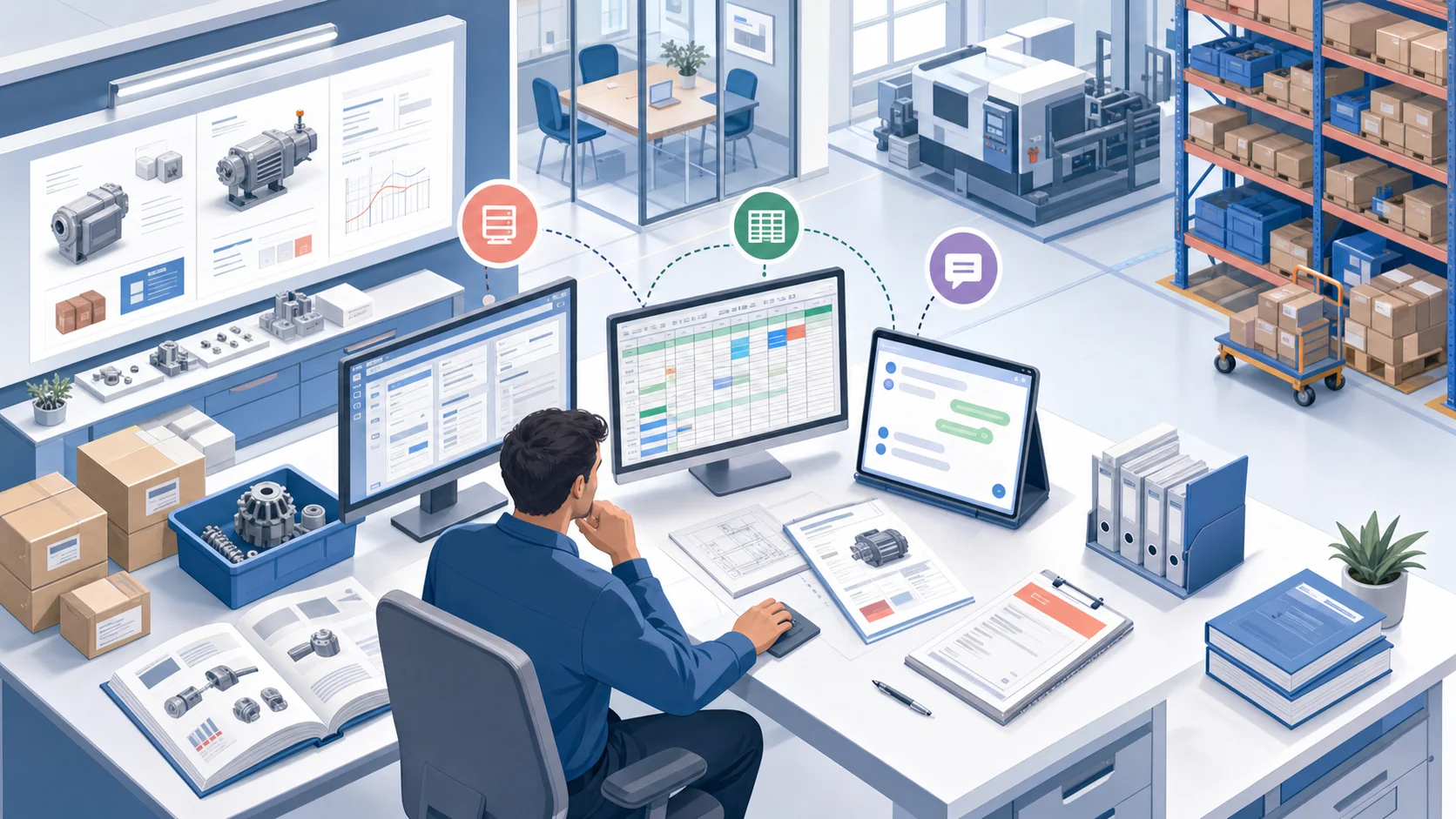
Executive diagnosis
The management point is simple: as the company grows, a manual commercial process stops being flexible and starts consuming selling capacity. It does not show up as one obvious failure; it shows up as small delays, data that must be validated twice, and opportunities that never reach the system.
| Observable signal | Operating cause | Business impact |
|---|---|---|
| Simple quotes take 10 to 20 minutes and technical quotes take hours. | Sellers rebuild every proposal from scratch, searching products, files, prices, and images. | Slower response and fewer opportunities processed each week. |
| Stock, price, and credit are confirmed by phone or chat. | The data exists, but is not trusted or actionable enough for sales. | More waiting, more customer friction, and a higher chance of losing to a faster supplier. |
| Excel defines discounts, versions, and approvals. | The ERP records, but does not support the commercial decision before the order. | Lower traceability, more discretion, and margin risk. |
| WhatsApp contains critical agreements. | The channel works, but is not connected to the formal flow. | Seller dependency and loss of context for operations, finance, and management. |
| Sellers spend the day taking orders. | Operations consume time that should go to account development. | More expensive growth: the company hires administrative capacity with commercial titles. |
The real cost is not software: it is lost commercial capacity
Many companies diagnose the issue as an adoption problem: "the team does not use the ERP correctly", "salespeople do not register activity", "we need more training".
Some of that may be true. But the larger cost is elsewhere: the company is spending commercial capacity on work that does not create relationships, negotiation, or new business.
In mid-sized industrial operations, it is common to see sellers spend more than half of their time on operational tasks: searching for information, copying line items, validating stock, chasing approvals, building documents, checking payment status, answering repetitive questions, and reconstructing commercial conditions.
That time does not come back. Across a full team, it becomes a structural loss.
| Manual activity | Typical unit time | What happens at scale |
|---|---|---|
| Checking stock in ERP or an old system | 1 to 3 minutes per lookup | The seller stops responding in the field and starts calling the warehouse. |
| Building a simple quote | 10 to 20 minutes | 15 quotes a day consume several productive hours. |
| Preparing a technical quote | 2 to 3 hours | The company can only answer the opportunities it has time to process. |
| Validating price, margin, or discount | 5 to 30 minutes | Approvals become a bottleneck and the customer compares alternatives. |
| Reworking a PDF, image, or technical sheet | 5 to 15 minutes | Proposal quality depends on patience, not on process. |
| Checking credit or collections | 5 to 20 minutes | The seller discovers too late that the customer cannot buy or receive. |
If a team of 10 sellers loses two hours per day to tasks that could be automated or centralized, that is 100 hours of commercial capacity blocked every week. Those hours could be used for visits, customer recovery, account expansion, opportunity follow-up, and contract negotiation.
That is why this is not a minor systems issue. Manual selling changes the work sellers actually do.
An industrial quote is a technical operation
In industrial B2B, quoting is not always a matter of adding a SKU and a quantity to a document.
A heavy-industry supplier may need to quote equipment that combines circuits, meters, imported components, local parts, assembly, technical documentation, costs, target margin, and a final proposal written in the customer's language.
The seller or specialist has to interpret the need, review manuals, find compatible parts, decide what technical detail to show, transform supplier information, calculate costs, defend margin, add images, include technical sheets, and produce a clear proposal.
That work requires judgment. It should not be treated as clerical work.
| Step in a technical quote | Real work behind it | Risk if manual |
|---|---|---|
| Understand the need | Translate the customer's request into products, parts, or a solution. | Quote something incomplete or technically wrong. |
| Find alternatives | Review manuals, catalogs, parts, and compatibility. | Lose time or recommend a substitute that does not apply. |
| Calculate price | Combine cost, margin, freight, FX, discount, and validity. | Price too high and lose, or too low and destroy margin. |
| Prepare the proposal | Build descriptions, photos, technical sheets, and layout. | Send weak or inconsistent documents. |
| Validate execution | Confirm stock, delivery, credit, and approval. | Promise something the company cannot fulfill. |
When that flow happens in Excel, Word, email, and WhatsApp, every quote becomes a small project. The company may have great products and strong sellers, but still answer too late.
The competitive advantage appears when the commercial layer already has the context: products, manuals, technical sheets, images, stock, prices, rules, history, and output format. Then the quote no longer starts from zero.
The ERP records the sale, but does not always help sell
The ERP plays a critical role. Orders, invoices, official inventory, accounts receivable, customers, suppliers, accounting, and operational data should live there.
But in many industrial companies, the ERP behaves more like a system of record than a commercial execution tool. It may create the order or invoice, but it does not necessarily help the seller decide what to offer, how to quote, at what price, with what margin, with what documentation, and under what conditions.
The experience is often slow, rigid, and not mobile. Sellers need a computer, VPN, mandatory fields, exact product codes, and a sequence built for transaction recording rather than customer conversation.
So a parallel path appears:
- The customer asks for something through WhatsApp, a call, or a visit.
- The seller finds the product in a catalog, spreadsheet, PDF, or memory.
- Stock is checked in ERP, in another system, or by calling the warehouse.
- Discount and margin are calculated in a spreadsheet.
- Approval is requested through email or messaging.
- A PDF is built in Word, Excel, or a custom tool.
- Only after the customer accepts does the order enter the ERP.
From the ERP's perspective, the sale began when the order was created. From the commercial perspective, it began much earlier.
That is where the full story disappears.
When people do not trust the data, everything is validated twice
A classic sign of low commercial maturity is not the absence of information. It is that nobody trusts the information enough to act on it.
The system shows stock, but the seller calls anyway. The ERP has a price, but procurement or finance validates it again. The credit line appears on screen, but someone asks for confirmation. Margin exists in theory, but it is rebuilt in Excel. A price list exists, but the team believes it is outdated.
Sales becomes slow because the commercial team operates in permanent audit mode.
| Data that should enable selling | What happens when people do not trust it |
|---|---|
| Available stock | The seller does not promise until calling the warehouse or checking another system. |
| Current price | The quote waits for validation before going out. |
| Cost and margin | Discount decisions happen late or with incomplete data. |
| Credit line | The sale stops after commercial time has already been spent. |
| Purchase history | The seller does not know what to reorder, offer, or recover. |
| Technical files | The proposal depends on manually finding documents. |
This distrust has a cause. Many companies have accumulated custom integrations, misused ERP fields, old reports, parallel spreadsheets, and processes that only one person understands. Even simple changes, such as updating a logo or proposal format, can become expensive if they depend on an old integration or outside implementer.
When the tool does not support the operation, the team invents shortcuts. When shortcuts become permanent, the company loses governance.
Excel is not the enemy; Excel as the commercial system is
Excel is one of the best operational tools ever created. Industrial sales teams use it because it is fast, flexible, familiar, and good for calculating, copying, comparing, downloading, correcting, and sharing information.
A modern platform should coexist with Excel when it adds value: exporting lines, loading bulk orders, reviewing conditions, simulating scenarios, or letting users work in a table format.
The problem is different: Excel becomes dangerous when it replaces the commercial system.
That happens when the supplier catalog is in one spreadsheet, the quote in another, the discount in another tab, the approval in an email, historical quotes in personal folders, and the macros in one person's head.
| Healthy Excel use | Control-destroying Excel use |
|---|---|
| Export a quote for review. | Create official quotes with no traceability. |
| Bulk load lines with validation. | Manually copy products between spreadsheets and ERP. |
| Simulate price or margin. | Define discounts without rules or audit trail. |
| Share a table internally. | Store commercial history in personal files. |
| Complement a structured flow. | Cover every bottleneck in the central process. |
The question is not whether the company uses Excel. The question is what happens if the file is lost, the person who knows the macro leaves, or a customer asks which version of the quote was approved.
If nobody can answer, Excel stopped being a tool and became operational risk.
WhatsApp is the real channel, but not the operational archive
WhatsApp works because customers use it. It is fast, informal, and effective for urgent questions: "do you have stock?", "can it arrive today?", "what price did we agree on?", "send me the quote", "I need the alternative product".
In the field, WhatsApp is often more useful than any portal. The seller can send an audio message, receive a photo, confirm a condition, and move forward.
The problem appears when WhatsApp becomes the company's operational archive.
A conversation may contain price, payment terms, delivery date, alternative product, informal approval, claim, or scope change. If that context is not connected to the quote, customer, or order, the rest of the company works blind.
The solution is not to ban WhatsApp. It is to turn it into an input to the process, not a replacement for the process.
A good commercial system should convert an audio message, text, or customer request into a structured action: find product, suggest substitute, check stock, prepare quote, request approval, generate PDF, and register context.
The channel can remain human. The record should not remain artisanal.
Field sellers need answers, not archaeology
In many industries, the sale is won during a visit. The customer may not be digitally sophisticated. The relationship matters. Trust matters. Urgency matters.
But the seller often arrives without the information needed: history, credit line, overdue payments, recurring products, opportunities, stock, price, margin, technical sheets, and dispatch status. To answer, they call, message, connect through VPN, or return to the office.
In that time, the customer may buy from someone else.
The ideal experience is not futuristic. It is concrete:
- see the customer's purchase history;
- know what they reorder and what they stopped buying;
- detect categories not yet penetrated;
- see credit, debt, and pending payments;
- check stock by warehouse and sellable availability;
- receive product and price recommendations;
- generate a quote from mobile;
- send a PDF with images, technical sheets, and terms;
- leave everything registered for operations, finance, and management.
That does not replace the commercial relationship. It strengthens it, because the seller arrives with a better proposal and answers while the customer is still deciding.
Sellers became order takers
A phrase repeats across industrial companies: "it is hard to find good sellers".
It is true that selling technical products requires experience. But many times the problem is not only talent. It is that the company turned sellers into order takers.
The seller built the relationship, won the account, and understands the customer. But then much of the day goes into receiving orders, checking stock, building quotes, validating credit, requesting approvals, sending PDFs, and chasing statuses.
That has a strategic consequence: the company grows by hiring more sellers to absorb more operational load, not necessarily to open more market.
| Work where sellers create value | Work that should be reduced |
|---|---|
| Develop new accounts. | Type order lines. |
| Expand categories in existing customers. | Search for files and images manually. |
| Negotiate strategic contracts. | Recalculate discounts in spreadsheets. |
| Defend margin with judgment. | Call to confirm basic stock. |
| Understand customer needs. | Reconstruct quote versions. |
| Recover dormant customers. | Chase approvals without context. |
The right automation does not threaten the seller. It protects them. It removes operational work so they can sell again.
The loss does not always show up in the invoice
The most dangerous part of this problem is that it often does not show up as an accounting error.
The final invoice may be correct. The order may be registered. The ERP may close the month. But the company still lost sales before they ever existed in the system.
It lost the customer who asked for stock and did not get an answer in time. It lost the opportunity that was never quoted because it took too long. It lost margin because price was validated too late. It lost a category because nobody noticed the customer was buying it from a competitor. It lost productivity because a seller spent the morning building documents instead of visiting accounts.
A reasonable estimate in many industrial companies is that 20% to 30% of commercial capacity is diluted in manual tasks, internal waiting, and rework. Not all of that becomes recoverable revenue, but it shows the size of the issue.
The question for management should not be "how much does the software cost?". It should be:
- how much margin do we lose by quoting late or poorly?
- how many opportunities do we never see because leads and quotes are not registered?
- how much seller time goes into validating data that should be available?
- how many customers buy from competitors because we respond slowly?
- how many sellers do we need just to sustain administrative load?
That is the real economics of modernizing B2B sales.
What needs to change
The path does not start by replacing everything, killing Excel, banning WhatsApp, or changing the ERP every time sales gets frustrated.
The answer is creating a commercial layer that organizes daily execution and connects to the sources of truth.
That layer should:
- search products, alternatives, parts, and documentation;
- consult stock and actionable availability;
- apply customer, list, volume, and context-based prices;
- calculate margin before sending;
- request approvals with clear rules;
- generate quotes with images, technical sheets, and versions;
- work from desktop and mobile;
- turn conversations into records;
- import or export Excel when useful;
- return clean orders, invoices, or documents to the ERP.
The thesis is not that the seller matters less. It is the opposite: when a company sells complex products, commercial judgment matters too much to waste it on administration.
Management implications
Industrial companies do not lose competitiveness overnight. They lose it through hundreds of small frictions: a quote that takes two hours, stock that must be confirmed by phone, a discount approved too late, a technical sheet nobody can find, a customer that was not followed up, a seller who no longer prospects because they are taking orders.
While the buyer was also manual, that model could survive. But customers are becoming faster, more digital, and better at comparing suppliers. If the supplier still depends on slow ERP screens, loose spreadsheets, and WhatsApp as the system of record, the gap becomes commercial, not technical.
Modernizing industrial B2B sales is not buying software to look modern. It is recovering commercial capacity, protecting margin, and preparing sellers to compete in a market where response speed and proposal quality matter more every year.
Related use cases
These pages connect the article topic with concrete operational workflows you can review during a commercial or technical evaluation.
ERP-Connected Sales
Sell faster on top of your ERP
Build reliable commercial workflows with clear rules, automated approvals, and executable outputs.
B2B Sales via WhatsApp Business
Turn WhatsApp into your central commercial system
Control, standardize, and scale B2B sales where they actually happen: on WhatsApp.
Continue reading
Jun 28, 2026
The B2B portal that works does not replace the seller: it extends commercial capacity
Many industrial companies have invested in B2B portals hoping customers will self-serve. The idea is reasonable: if buyers can see catalog, prices, stock,...
Jun 28, 2026
WhatsApp can be an official B2B sales channel if the company governs it well
In Latin American B2B sales, WhatsApp is not a marginal channel. For many buyers and sellers, it is the main channel for daily coordination. Stock questions,...
Oct 1, 2025
Sales Assistant available on WhatsApp
Sales teams do not always work from a desk. They are in a warehouse, on the road, inside a customer plant, or between meetings when a buyer asks a practical...
Automate your B2B sales with Recerc
Customer portal, AI-powered quotes, digital catalog and more. Everything you need to scale your commercial operation.