The B2B portal that works does not replace the seller: it extends commercial capacity
This page is part of our content cluster on B2B sales, pricing, ERP-connected workflows, and commercial automation. If you are evaluating software or researching best practices, use the related links at the end to continue deeper.
Many industrial companies have invested in B2B portals hoping customers will self-serve. The idea is reasonable: if buyers can see catalog, prices, stock, orders, and invoices, the commercial team should receive less operational load and sell more.
The problem is that a B2B portal does not work just because it exists. It works when it fits the type of purchase, the customer's autonomy, and the maturity of the supplier's internal process.
Forcing every buyer to use a portal as step zero often fails. In many cases, calling, sending a WhatsApp message, or writing an email is still better than searching for technical product names, seeing prices that do not feel correct, and checking stock the customer does not trust.
The B2B portal that works does not replace the seller. It extends commercial capacity.
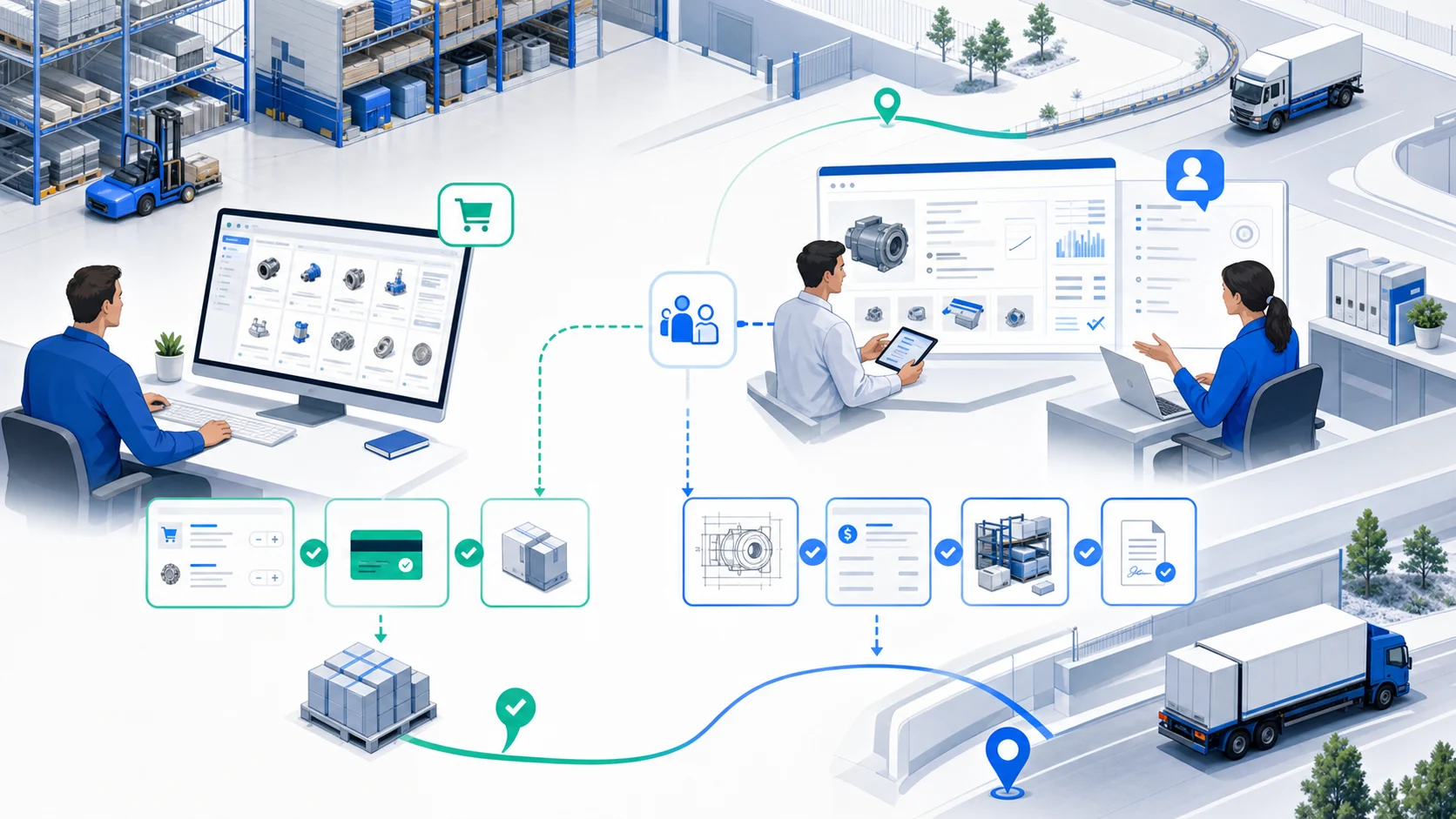
Where self-service has immediate adoption
Self-service works best when the purchase is recurrent, the customer already knows what they need, and conditions are clear.
| Case | Why it works |
|---|---|
| Framework agreement | Products, prices, and terms are already defined. |
| Recurrent reorder | The buyer repeats known SKUs and needs speed. |
| Low-value operational purchase | Experience and delivery matter more than negotiation. |
| Order or invoice status | The customer needs information, not advice. |
| Document download | Technical sheets, certificates, or invoices can be served without human interaction. |
In these cases, the portal reduces friction for both sides. The customer gains autonomy and the seller stops answering questions the system can handle better.
Where the portal fails
The portal fails when it tries to replace a process that still requires advice, negotiation, or validation.
In industrial sales, customers often do not know the exact product name, do not know how much to buy, use competitor references, need alternatives, expect negotiated prices, or require confirmation of technical application.
If the portal does not solve that, it becomes worse than the human channel.
| Situation | Why the portal is not enough |
|---|---|
| Technical or ambiguous product | The customer needs translation from need to SKU. |
| Customer-specific prices | The buyer does not trust prices that differ from history. |
| Negotiated purchase | The decision depends on volume, margin, contract, or exception. |
| Uncertain stock | The customer needs promise, date, and alternative. |
| High-impact purchase | Operational risk requires human validation. |
| Low digital maturity | The cost of using the portal exceeds perceived benefit. |
The mistake is assuming that buying industrial supplies behaves like retail. It often does not.
The portal should not be step zero
Many implementations fail because they start with the visible channel instead of the operation behind it.
Before pushing self-service, the company needs:
- clear catalog;
- robust search;
- customer-specific prices;
- reliable stock;
- technical documents;
- purchase history;
- credit validations;
- approval flow;
- ERP integration;
- order and invoice status;
- exception handling.
If that does not exist, the portal only exposes internal disorder.
The portal as an extension of the seller
The best approach is designing the portal as an extension of the commercial relationship.
The seller can use it to prepare carts, share lists, recommend products, leave preapproved prices, enable reorders, and provide order visibility. The customer can use it for repetitive work without losing access to the seller when advice is needed.
| Portal function | How it extends the commercial team |
|---|---|
| Quick reorder | Reduces manual orders and frees seller time. |
| Personalized catalog | Shows what is relevant to each customer. |
| Buying lists | Organizes recurrent products by project, plant, or area. |
| Order status | Reduces operational inquiries. |
| Documents and technical files | Improves information quality without asking the seller. |
| Request for quote | Captures structured demand for follow-up. |
| Recommended products | Helps expand categories. |
The portal does not compete with the seller. It gives the seller a digital surface to serve better.
Progressive migration, not imposition
B2B portal adoption usually requires transition.
First, enable high-value, low-friction use cases: reorder, documents, order status, invoices, personalized catalogs. Then add quotes, dynamic prices, purchase approvals, purchase order integration, and recommendations.
| Stage | Objective |
|---|---|
| Information | Let the customer consult documents, invoices, and status. |
| Reorder | Let known purchases repeat without friction. |
| Assisted quote | Let customers request structured proposals without leaving the flow. |
| Advanced self-service | Let customers buy with rules, prices, and reliable stock. |
| Integration | Connect the customer's purchasing system to the supplier. |
Forcing the portal before solving the experience can reduce adoption and sales. Promoting it after organizing the commercial layer can multiply productivity.
Management implications
A B2B portal should be evaluated by its ability to reduce friction and increase profitable sales, not by an abstract percentage of registered customers.
The right questions are:
- Which purchases can self-serve without hurting experience?
- What information does the customer repeatedly ask for?
- Which cases still require a seller?
- What internal conditions must be solved before exposing them?
- How do we measure adoption by value, not login?
The portal that works does not force the customer to change channels overnight. It offers a better way to do what the customer already wanted, and leaves the seller free to work where they add real value.
Related use cases
These pages connect the article topic with concrete operational workflows you can review during a commercial or technical evaluation.
B2B Buyer
Deliver fast, clear, and trustworthy quoting experiences
Provide visibility and consistency across sellers, portals, and digital channels.
Pricing Governance
Stop margin leakage with automated pricing guardrails
Centralize pricing logic and approvals so sellers can move fast without breaking policy.
Continue reading
Jun 28, 2026
ERP as source of truth and the commercial layer as the industrial execution system
For years, many industrial companies tried to run their commercial operation directly from the ERP. The logic sounded reasonable: if the ERP has customers,...
Jun 28, 2026
The commercial team of the future does not take orders: it develops accounts with operational intelligence
In many industrial B2B companies, the commercial team spends much of its time receiving orders, validating stock, copying lines, preparing quotes, requesting...
Jun 28, 2026
Available stock is not sellable stock: the difference that defines the customer promise
In industrial B2B sales, few questions sound as simple as "do we have stock?". Behind that question sits a critical distinction: stock in the system is not the...
Automate your B2B sales with Recerc
Customer portal, AI-powered quotes, digital catalog and more. Everything you need to scale your commercial operation.