B2B quote-to-cash: how to control the sale before it reaches the invoice
This page is part of our content cluster on B2B sales, pricing, ERP-connected workflows, and commercial automation. If you are evaluating software or researching best practices, use the related links at the end to continue deeper.
Many B2B companies believe their quote-to-cash process is under control because they invoice, collect, register orders, and close accounting periods. From the ERP's point of view, that may be true. The invoice exists, accounts receivable are registered, and someone can check payment status.
Commercially, that view arrives late.
The sale started much earlier: when a customer asked for a product, when a seller visited an account, when an opportunity was not managed, when a quote went out late, when a price was offered, when a delivery was promised, when a discount was approved, when the team discovered too late that the customer was blocked by credit.
Quote-to-cash is not "quote and collect". It is the flow that turns demand into cash collected, passing through customers, opportunities, quotes, prices, approvals, orders, availability, fulfillment, invoicing, collections, returns, procurement, inventory, and business rules.
If the company only manages from the closed order or invoice, it is looking at the result. It is not managing the system that produced the result.
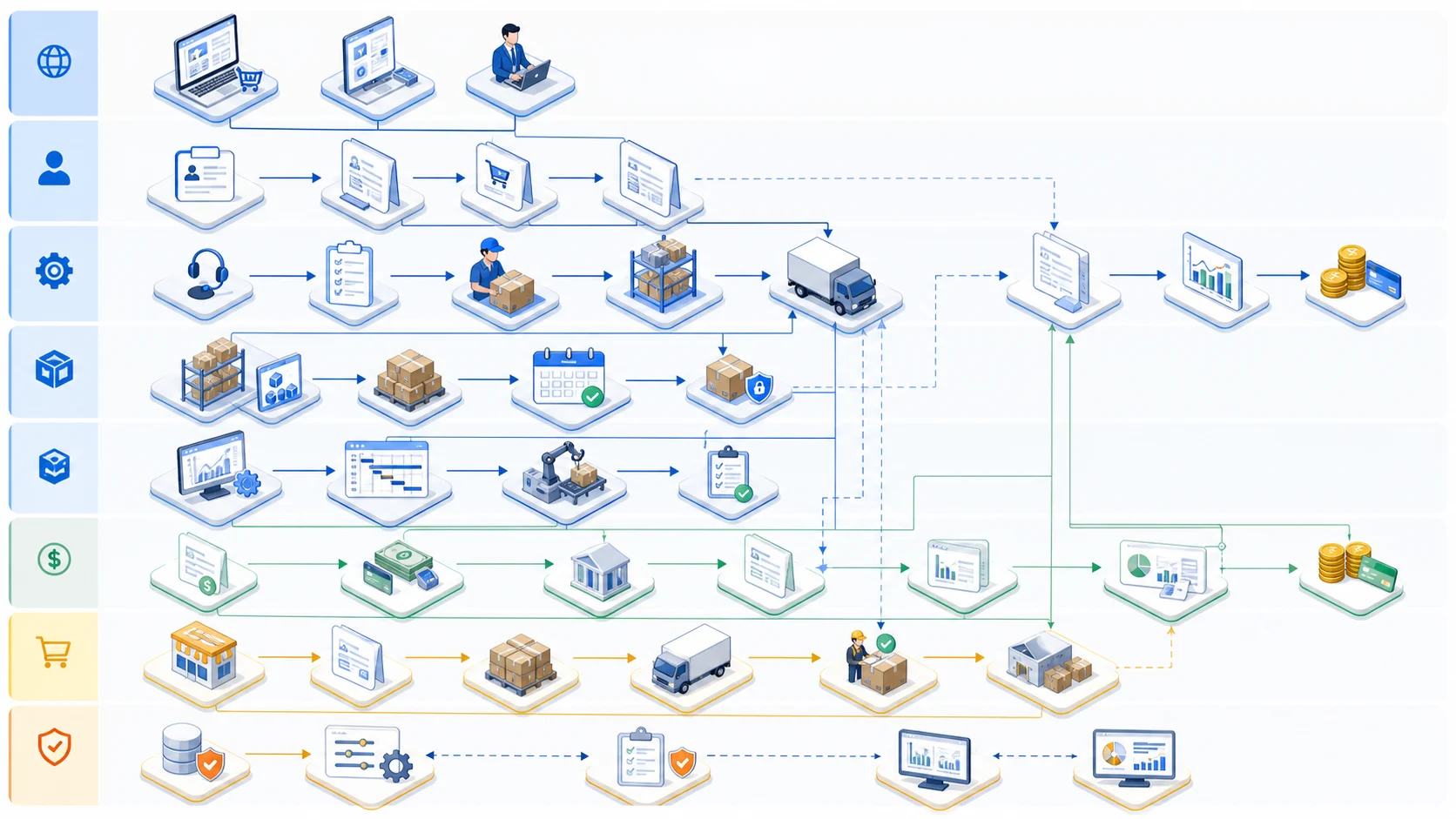
Executive diagnosis
The biggest shift is moving from managing final documents to managing the flow that produces those documents. The invoice shows the result; quote-to-cash shows the decisions that explain it.
| If the company only looks at... | What it sees | What it misses |
|---|---|---|
| Invoicing | Closed sales and issued documents. | Lost quotes, prices that did not win, and demand that was never answered. |
| Closed orders | What the customer already accepted. | Delays, approvals, credit, stock, and negotiation before the order. |
| Accounts receivable | Debt, payments, and blocks. | How that information affects the next sale and the commercial relationship. |
| Total inventory | Physical or accounting quantity. | Sellable availability, reservations, waste, incoming stock, and the real customer promise. |
| Seller activity | Visits or final sales. | Opportunity management, portfolio follow-up, and invisible operational work. |
The full flow is larger than sales and finance
In an industrial company, quote-to-cash crosses several operating layers.
It starts in channels: sellers, stores, e-commerce, B2B portals, marketplaces, integrations, and recurring purchases. Then it enters the commercial layer: leads, opportunities, customers, quotes, contracts, and sales orders. It continues through operations: support, field service, order release, picking, packing, and dispatch. It connects with inventory, production, finance, procurement, and transversal rules.
One simple way to see it:
| Layer | What happens | Why it matters for quote-to-cash |
|---|---|---|
| Channels | Sellers, stores, B2B portals, marketplaces, integrations, e-commerce. | Demand enters through multiple places and must become traceable. |
| Commercial | Leads, opportunities, quotes, contracts, orders, returns. | This defines what is promised, to whom, at what price, and under what terms. |
| Operations | Customer support, field service, order release, pick & pack, dispatch. | The commercial promise becomes execution. |
| Inventory | Control, replenishment, availability, ATP, reservations, receiving. | Determines whether the company can fulfill what it sold. |
| Production | Planning, work orders, execution, quality, and receipt. | In make-to-order or assembled products, selling may require producing or preparing. |
| Finance | Prepayments, invoice, receivables, collections, payments, reconciliation. | The sale is complete only when money is collected and applied correctly. |
| Procurement | Suppliers, sourcing, purchase orders, receiving, supplier invoices. | If product is missing, the commercial flow depends on purchasing and lead times. |
| Enablers | Master data, rules, approvals, permissions, audit, reporting, integrations. | Without rules and traceability, the flow depends on people and invisible exceptions. |
This is why quote-to-cash gets messy: it does not belong to one team. It is a chain of commitments across functions.
The invoice is the end, not the management system
Invoicing, accounts receivable, accounts payable, and inventory usually have some level of record. The data may be imperfect, reconciled late, or hard to query, but it normally exists. Someone in finance, operations, or warehouse can reconstruct it.
The problem is that this information does not always reach the place where it is needed: the point of sale, the seller in the field, the commercial manager, the customer portal, or the quoting flow.
The seller may not see that the customer is blocked. They may not know what stock is truly available. They may not understand that an overdue invoice will stop dispatch. They may not see that the customer stopped buying a key category six months ago.
The company has records, but not action.
| Information that exists somewhere | Real problem |
|---|---|
| Stock by warehouse | Sales does not see actionable availability when quoting. |
| Accounts receivable | The seller discovers too late that the customer is blocked. |
| Invoices and payments | The commercial relationship does not incorporate account health. |
| Sales history | It does not become opportunities, reorders, or cross-sell. |
| Claims and support | They do not inform account strategy or the next visit. |
| Costs and margins | They do not arrive in time to define the winning price. |
That is why organizing quote-to-cash is not only improving the back office. It is moving operational information to the moment where the sale is decided.
Where visibility is really missing
The weakest visibility is often before the quote and around active account management.
Many companies know how much they invoiced. They know which customers owe money. They know how much stock exists in some report. But they do not know with the same clarity:
- which leads entered and who managed them;
- which opportunities exist in each portfolio;
- which customers are not being followed up;
- which products the market is requesting;
- which quotes are lost because of price, delay, or stock;
- which claims should change account strategy;
- which categories the customer is buying from competitors;
- which sellers are taking orders versus developing business;
- which prices win and lose by segment.
The company has a good reading of the result and a weak reading of the cause.
| Zone of the flow | Typical record level | Risk |
|---|---|---|
| Leads and opportunities | Low or irregular. | Unmanaged demand, dormant customers, weak prospecting. |
| Quote and approval | Medium, often in Excel/email. | Margin loss, delays, uncontrolled versions. |
| Sales order | High in ERP. | Seen late, after the promise already exists. |
| Fulfillment and dispatch | Medium/high in operations. | Information does not always return to sales or the customer. |
| Invoicing and collections | High in finance. | Used for closing, not always for commercial action. |
| Returns and claims | Variable. | Learning about product, service, and account is lost. |
The modernization focus should not be only digitizing documents. It should be closing the gap between recorded information and actionable information.
A poorly managed quote can destroy value across the chain
The quote looks like a commercial document. In reality, it is an operational promise.
When quoting is poorly managed, the problem does not stay in sales. It flows into margin, inventory, dispatch, invoicing, collections, and customer experience.
| Quote issue | Downstream effect |
|---|---|
| Price too high | The customer buys from a competitor and the loss is not always registered. |
| Price too low | The sale converts, but margin is lost or approval arrives late. |
| Stock not validated | Operations cannot fulfill and the promise breaks. |
| Customer blocked by credit | The sale stops after commercial work has already been done. |
| Wrong product or missing file | Return, claim, or loss of trust. |
| Delivery promised incorrectly | Logistics cost increases or the deadline is missed. |
| Informal WhatsApp condition | Finance or operations does not understand what was agreed. |
Concrete example: a customer asks for a product during a visit. The seller does not have stock, price, credit, and margin in one view. They have to call the warehouse, ask finance, validate with a manager, and review a spreadsheet. While waiting, the customer buys from another supplier.
That sale never reached an invoice. But it was a real loss.
Another example: an old customer stopped buying. Nobody noticed because there was no active account management. During a visit, the evidence appears: the customer's warehouse is full of competitors' products. The company did not lose one order. It lost relationship, recurrence, and share of wallet.
That part of quote-to-cash does not appear in the ERP if you only look at closed documents.
A blocked customer is a flow failure, not only a collections issue
A common case: the seller works an opportunity, prepares the quote, negotiates, builds the order, and only at the end discovers the customer is blocked because of credit, interest, or overdue invoices.
Finance did its job: protect cash and risk. But the full flow failed, because that information reached the commercial conversation too late.
The result is bad for everyone:
- the customer gets angry because nobody warned them;
- the seller loses time and credibility;
- finance becomes the area that says no;
- operations does not know whether to prepare the order;
- the company may renegotiate under pressure;
- and the sale may be lost.
The solution is not removing controls. It is moving them earlier.
A mature quote-to-cash process lets the team know, before quoting or promising:
- whether the customer has available credit;
- whether meaningful invoices are overdue;
- whether there are open disputes;
- whether prepayment is required;
- whether risk approval is needed;
- which commercial condition can be offered;
- and what conversation the seller should have before moving forward.
That does not turn sellers into collectors. It lets them sell with context.
Inventory: knowing how much exists is not the same as knowing what can be sold
Many companies "know" their stock. They have inventory, warehouses, movements, and reports. But selling well requires more than on-hand quantity.
The seller needs commercial availability:
- how much is available;
- where it is;
- what is reserved;
- what is committed;
- what is damaged, written off, or not sellable;
- what is arriving soon;
- what can ship today;
- what substitute exists;
- what purchase or production action must be triggered.
That is why the operating blueprint separates inventory control, availability/ATP, allocation/reservation, and receiving/put-away. Each answers a different question.
| Concept | Question it answers |
|---|---|
| Stock on hand | How much physically exists? |
| Available / ATP | How much can I promise to the customer? |
| Reserved | What quantity is already committed to another sale, production, or hold? |
| Incoming | What is coming from suppliers or production? |
| Waste / quality | What exists but should not be sold? |
| Location | From which warehouse can I fulfill, at what cost and time? |
If sales only sees total stock, it may promise incorrectly. If it sees nothing, it responds late. Both destroy customer experience.
Procurement and production are also part of quote-to-cash
In simple distribution, the company buys products, stores them, and sells them. But many industrial B2B businesses are more complex.
Sometimes product must be purchased because stock is missing. Sometimes it must be assembled. Sometimes it must be produced in batches. Sometimes supplier, lead time, quality, receiving, cost, and dispatch must all be coordinated. Sometimes margin depends on a replacement cost that is not yet final.
That is why quote-to-cash connects with procurement and production.
| Case | Commercial impact |
|---|---|
| Product out of stock, but supplier available | The promise depends on lead time and purchase cost. |
| Imported product | Price depends on FX, freight, customs, and timing. |
| Assembled product | The sale depends on components, work order, and capacity. |
| Quality-controlled product | Availability depends on receiving and release. |
| Recurring contract | The promise depends on planning and replenishment ahead of time. |
When these layers are not connected, sales promises with incomplete information and operations receives already-committed problems.
The mistake of looking only at closed orders
The closed order is a good signal. The invoice too. But both are late signals.
If a company manages only from orders and invoices, it leaves out:
- real pipeline;
- dormant customers;
- opportunities never created;
- lost quotes;
- prices that did not win;
- products with unmet demand;
- approvals that delayed the sale;
- sellers overloaded with manual work;
- margin lost before invoicing;
- reasons why a customer went to a competitor.
The invoice says what was sold. It does not say everything that could have been sold.
A commercial manager who only looks at revenue may think the operation is stable, while the team is losing opportunities before they become visible.
Metrics that should exist before the invoice
To manage quote-to-cash properly, the company needs early signals.
| Pre-invoice metric | What it helps decide |
|---|---|
| Leads by channel and management rate | Whether incoming demand is being worked or lost. |
| Opportunities by portfolio | Which customers have potential and which are abandoned. |
| Time to first quote | Whether the company responds at competitive speed. |
| Approval time | Which rules or people are slowing sales. |
| Quotes per seller | Operational load and commercial productivity. |
| Quote-to-order conversion | Offer quality, price, follow-up, and fit. |
| Winning price vs. losing price | Real competitive range by product and customer. |
| Quoted margin vs. invoiced margin | Margin leakage between promise and execution. |
| Lost sales due to stock | Commercial cost of availability and replenishment. |
| Customers without recent activity | Risk of portfolio loss. |
| Unpenetrated categories | Cross-sell and expansion opportunities. |
| Credit blocks before quote | Financial risk detected early. |
These metrics change the conversation. It is no longer only how much was sold, but what commercial system produced that sale and what opportunities are being left behind.
Functions do not fail alone: handoffs fail
Sales, warehouse, operations, finance, and procurement usually have valid reasons.
Sales wants to answer quickly. Warehouse does not want to promise stock that does not exist. Finance wants to protect credit and margin. Operations wants to dispatch correctly. Procurement wants to buy well. Production wants to plan.
The problem appears in handoffs:
- lead to opportunity;
- opportunity to quote;
- quote to approval;
- approval to order;
- order to reservation;
- reservation to picking;
- dispatch to invoice;
- invoice to collections;
- collections to next sale.
Each handoff can lose context.
A good quote-to-cash process does not require everyone to use the same screen all day. It requires everyone to work from the same commercial timeline: what the customer asked for, what was offered, what was approved, what was promised, what was reserved, what was delivered, what was invoiced, what was collected, and what remains pending.
The informal part is larger than leadership thinks
In many companies, quote-to-cash is more informal before the order than management imagines.
Lead management may not exist. Opportunities may live in the seller's head. Quotes may be built through WhatsApp, Excel, or manual PDFs. Approvals happen in chat. Claims stay in phone calls. Lost reasons are not recorded. Portfolios are managed by memory.
That informality is not laziness. Often, it is the only way to sell with slow systems.
But as buyers become more digital, informality becomes a disadvantage. If a customer can quote massively with AI, compare suppliers, and receive faster answers, the supplier that depends on internal calls and spreadsheets loses speed.
Organizing quote-to-cash is preparing to compete
The operating conclusion is this: organizing quote-to-cash is not an administrative project. It is preparing the company to compete in a market where buyers will have more technology than before.
Today, many sales still happen traditionally. Sellers receive orders, negotiate, visit, call, quote, and solve. That model can continue for years, especially in trust-based relationships.
But the standard is changing. Buyers will compare faster, request quotes in parallel, automate recurrent purchases, use AI agents, and expect more visibility. If the supplier does not modernize its commercial layer, it will operate slowly against customers that buy faster.
Organizing quote-to-cash helps:
- improve customer experience;
- respond faster;
- protect margin;
- reduce operating cost;
- turn history into opportunities;
- connect sales with stock, credit, and dispatch;
- avoid late blocks;
- measure what happens before invoicing;
- and prepare the company for progressive automation.
This is not about replacing the seller. It is about giving sellers a system that keeps them competitive in a new stage.
Management implications
The invoice is necessary, but it arrives late. The order is important, but it also arrives late. Collections close the cycle, but they do not explain why the company won, lost, or failed to sell.
Well-managed quote-to-cash starts earlier: in channels, leads, opportunities, portfolios, quotes, price, margin, credit, availability, and operational promises.
The company that organizes that flow stops managing only results and starts managing commercial capacity. That changes how B2B sales is run: leadership no longer asks only how much was invoiced, but which opportunities were seen, which were worked, what was promised, where the flow got stuck, what margin was defended, and which customer may be lost before it becomes obvious in the ERP.
That is the real value of quote-to-cash: turning a scattered chain of commercial, operational, and financial decisions into a system that helps the company compete better.
Related use cases
These pages connect the article topic with concrete operational workflows you can review during a commercial or technical evaluation.
Continue reading
Jun 28, 2026
ERP as source of truth and the commercial layer as the industrial execution system
For years, many industrial companies tried to run their commercial operation directly from the ERP. The logic sounded reasonable: if the ERP has customers,...
Jun 28, 2026
Well-designed commercial approvals accelerate sales instead of slowing them down
In many B2B companies, commercial approvals have a bad reputation. They are associated with bureaucracy, delays, managers who do not respond, and opportunities...
Jun 28, 2026
The commercial team of the future does not take orders: it develops accounts with operational intelligence
In many industrial B2B companies, the commercial team spends much of its time receiving orders, validating stock, copying lines, preparing quotes, requesting...
Automate your B2B sales with Recerc
Customer portal, AI-powered quotes, digital catalog and more. Everything you need to scale your commercial operation.